Friday, November 25, 2022

'Tis the Season

I enjoyed reading all the FB posts yesterday and today about what people are thankful for, and of course, I have my list as well – but it got me musing about the whole idea of having a single day out of the year to express that thankfulness. Thinking about what I am thankful for should be a daily practice rather than an annual one. And come to think of it, the whole holiday season is supposed to be one of being “jolly” and “merry” and “happy…”

I get that in early days, with the shortened winter days, and the cold and bad weather in much of the northern hemisphere, there is a need to try to keep spirits up. Thus, the tradition of lights on evergreen trees. I wrote a short poem years ago, that turned into an intro verse that my sister and I recorded along with Greensleeves (a.k.a. What Child is This) on a winter-themed CD we did with another harp duo. Here are the words for this single verse:

Even in the bleakest winter’s numb

The evergreen’s deep color of survival

Renews our faith that spring will surely come

And gives us strength to wait for her arrival…

I’d like to offer a gift of a download of this tune. The link will put you on my mailing list, which would mean you won't have to miss any of these blogs. You'll also be able to choose what kinds of emails you'll get from me. Here is a link to the download:

https://tinyurl.com/TheEvergreenGreensleeves

The song is not on Spotify or any other online service, but it is also on the CD “On a Snowy Eve” which can be purchased in the old-fashioned manner as a CD from my website. Here is a link to my website for the CD!

https://verlene.com/snowyeve.html

So yes, there is a need to look forward when we are going through the darkest moments whether it’s winter’s shortened days, or difficult times with health, relationships, finances, or anything else that makes us numb. How else do we cope?

I always write up a list of accomplishments and goals at the end of December as my way of both looking back and looking forward. I start by reading last year’s goals. I notice that I don’t always reach all of the goals I listed, but I have instead had several accomplishments that were not on the list.  

It’s a way to annually take into account what is working and what isn’t, what is important and what isn’t. So, in a way I hibernate into this place of looking deep within so that I can start anew – not making promises but setting goals that may or may not be as important in a few months. But it is a way to move forward. I intend to add “think of something to be thankful of each day of the year.” And that’s a goal I hope to add as an accomplishment next year…

Another song I wrote that you can hear on Spotify (or why not also consider buying the CD?) is called Persephone’s Art. The story of Persephone is from Greek Mythology. Here's a brief synopsis: 

Persephone goes into the underworld and eats 6 pomegranate seeds. She is then constrained to the underworld. Her mother Demeter goes looking for her and finding her trapped in the underworld, makes a deal with the gods to allow her to come back to live with her for 6 months of each year, one month for each pomegranate seed she ate.  So Persephone lives an annual cycle of fall and winter in the underworld, and spring and summer with Demeter tending to the garden. 

Some people think of this story as a negative, a compromise, or a "deal with the devil." I see it as positive. Nature is cyclic, we are cyclic. 

Here is a link to the song on Spotify:

https://tinyurl.com/spotifyPersephone

And here are the lyrics:

When Demeter and Persephone part
It isn't the end, it's only the start
Walk the perimeter then descend to the heart
Then return again, that's Persephone's art

Down, down, deep into the darkness
Mother weeps her crystalline tears
Daughter keeps her pomegranate promise
Now go to sleep and settle your fears

When Demeter and Persephone part
It isn't the end, it's only the start
Walk the perimeter then descend to the heart
Then return again, that's Persephone's art

Down, down, deep into the dark soil
Plant the seed in the warm womb of earth
You can reap the harvest of your hard toil
Such is the creed of death and rebirth

When Demeter and Persephone part
It isn't the end, it's only the start
Walk the perimeter then return to the start
Then return again, that's Persephone's art

Look, your daughter is dancing with her demons
Look, your mother has let her garden die
Look, the Lady is spinning with the seasons
Look inside if you wanna know why

When Demeter and Persephone part
It isn't the end, it's only the start
Walk the perimeter then descend to the heart
Then return again, that's Persephone's art

 And if you’d like the CD, you can find it here:

https://verlene.com/persephone.html

So, what am I most thankful for at this moment? Here’s my list:

  • My good health
  • My family and friends
  • My musical endeavors:
    • Playing harp at the Stanford Hospital Cancer Center again after 2 and a half years
    • Playing for so many years and still going strong with Silverwood (that’s the duo with my sister that you will hear on the downloaded song)
    • Playing with Gaelic Muses, which I joined in January
    • Teaching private students and all who have attended my online workshops (I’m taking the month of December off from the online workshops and will be back in January – look for the announcement of the class offerings at the end of December!)
  • And so much more!


    Friday, November 18, 2022

    Rested up and ready to face the holidays!

    Those who read my last blog post about Business/Busy-ness will know that I took a 7-day vacation to Arizona last week. To be able to commune with nature, hike, see new sights, visit the Musical Instrument Museum and become inspired by all of it has been restorative and healing in many ways.

    The season we are already moving into can be stressful to those who face travel to visit family, overbooked social commitments, and lots of gigs to try to stay healthy for, so my wish for each of you is to take time for yourself – feed your soul, get some sleep, rest up!!!  I’d love to share some highlights from my trip, so here we go!

    Our first two nights were spent in Prescott, Arizona – a lovely little town that we may try to return to again since our first full day was pretty much rained out. Once the rain stopped, the wind continued to whip around with very low temperatures we were not acclimated to, being from sunny California… But on our second day, on our way to Sedona, we made a stop at one of the many little lakes in the area, Lynx Lake, and did a 3.5 mile walk completely around the lake.


    We took off going clockwise, and then after we crossed the stream and soaked our shoes, wondering why there wasn’t a better place to cross, we came across a sign:


    Oh, okay, it would have been helpful to see that before we set out in the direction we went! But, there were other hikers and dog walkers on the other side of the lake, so we weren’t completely alone or in danger (much).

    Our next 2 nights were in Sedona, and having arrived in the late afternoon, we rested up for a longish hike the next day to Soldiers Pass. This was a 4.7 mile loop, and was fairly strenuous with lots of rock scrambling, and amazing vistas. A few highlights were a natural sinkhole called Devil’s Kitchen, the Seven Sacred Pools, and the Soldiers Cave.

          Soldiers Pass


    Devil’s Kitchen Sinkhole

     Seven Sacred Pools

     Soldiers Pass Cave

    While on the hike, we stood around with a group of hikers watching a helicopter rescue, which reminded us all to be very careful. These rocks are known to be vortexes and magical in some way, but it doesn’t mean you can’t fall 40 feet and be skewered by a tree limb…


    The day we left Sedona, we decided to do one more hike:  the short 1.5 mile loop around Bell Rock – it’s fairly flat, so we added a lot of steps (according to my Fitbit) with just a little effort. There are also several trails up to the top, but we were done climbing...


    Finally, we spent the last two nights in Scottsdale (a suburb of Phoenix), and our big outing was visiting the Musical Instrument Museum. I took hmm... probably a hundred photos mostly of stringed instruments from all around the world, and my biggest disappointment was not being able to reach out and try playing a tune on each and every one! I’d never seen a Peruvian harp up close, or a number of unusual bowed and plucked string instruments from around the world! But I also found many that I have in my small collection, and am actively playing. Here are some of the interesting harps:

    Pervian harp

    Frame harp from Tunguragau

    Irish harp with 7 levers on the pillar 

    Here are some of the stringed instruments I play or have played. The Swedish lute with bass strings was the predecessor of the harp guitar:                

    Nyckelharpa and lute with bass strings

    Harp guitar

    Chapman stick

    Each Chapman stick was numbered, and although you can’t see the numbers in the photo, when I was in Stickband decades ago, I played a borrowed stick numbered 284. I also sang some of my original songs, played my electric violin, Yamaha Electric Grand piano, and Moog Liberation synthesizer (that’s what I’m playing in this photo). I still have the violin, the tee shirt, and the hat!

    Jim Bruno & me at a Stickband concert in 1978 or 9

    We also did the guided tour of the special exhibit, and I was delighted when the docent explained that the Turkish Oud was originally developed by Armenian luthiers, but eventually became known as Turkish. As an Armenian, I was grateful that he gave credit where credit was due. I think this is a little-known fact… This photo shows the Armenia exhibit. Each country had a map, a video screen you could hear music through their provided headphones and receiver as you approached the exhibit. I felt I could have spent far more time here and highly recommend a visit if you’re ever in Phoenix!

    There were two concerts at the museum that we were able to attend – a wonderful classical guitarist, and an oud player who played accompanied by a keyboardist with a drum machine. So inspiring! Those who have taken my Middle Eastern workshop might enjoy watching this short video. By the way, the rhythm is the Maqsum rhythm:

    Maqsum   1          &   (2)  &    3           4

                     Doum  tek       tek  doum   tek 

     https://drive.google.com/file/d/1c209uVn7d8BBXkURk3H64M5nY5J-KCxa/view?usp=share_link

    So, now, back to teaching private students, a workshop tomorrow, several performances in Assisted Living facilities, concerts with Gaelic Muses, concerts with Harpers Hall, Thanksgiving and Christmas gatherings with family and friends, and yes, thanks to a lovely vacation, I think I’ll get through it all with a smile!

    Happy Holidays to you and your loved ones! 


    Tuesday, November 1, 2022

    Busy-ness

    I’ve often wondered why business was not spelled bizness or buisness  -- we don’t pronounce it as busy-ness do we? But that’s what it is and as it is, that’s also the word origin…

    Yep, I went to the web to research it and found this:

    Old English bisignis ‘anxiety’ (see busy, -ness); the sense ‘state of being busy’ was used from Middle English down to the 18th century, but is now differentiated as busyness . The use ‘appointed task’ dates from late Middle English, and from it all the other current senses have developed.

    And if you want to read a bit more, you can go here: https://tinyurl.com/businessorigin

    So, why am I musing about this now? I have had to apologize to a student this week, saying that I was too busy, and didn’t get around to sending a response to his work. That stressed me out because isn’t it my business as a teacher to respond in a timely manner? I was actually relieved to see the word “anxiety” in the word origin – although that has been dropped in current definitions of the word business. I do think there can be an aspect of anxiety to the “state of being busy” as most of us find ourselves a bit too busy for comfort. The pressures of deadlines don’t come from our play schedule – only from our businesses…

    Just to reassure you, my student said “hey, no problem” – he gets busy as well. And what I was busy with was more legitimate business – gigs, rehearsals, workshops… And this is also why my Friday blog is being written the following Tuesday…๐Ÿ˜–

    It’s a good thing to be busy with lots of work, but it’s not good to become overly busy to the point of becoming anxious. Not good for the blood pressure! Many large companies require employees to take time management courses, and some will require a certain amount of downtime.

    That’s great when the edict comes from above, but for those of us who are self-employed, we are the enforcer and the enforced, the leader and the follower. We have to be brave enough to set boundaries and limits and organized enough to schedule in that much-needed downtime.

    I wrote a song during a particularly stressful time (some years ago) and a friend thought it applies more to those in large corporations than to a self-employed musician. “What, you? Stressed? You have the ideal job!” And yes, I love everything I do in my music career, but it does take a conscious effort to take care of myself in addition to taking care of business.

    You can hear the song here:

     
    Stretching Me Thin
    Spotify Logo
    Verlene Schermer

    ​And here are the words:

    Stretching Me Thin

    © 2005 Verlene Schermer/BMI
    All Rights Reserved

    I can’t keep my head from spinning, I can’t keep a focus in my mind
    Can’t even remember why I’m running, and what I’m expecting to find
    How many years has it been, chasing after someone else’s deadline
    They keep stretching me, stretching me thin
    So thin that I might break if I don’t take some time

    Give me just a day to do nothing, Give me just a respite from the race
    This is no way to be living, Always on the run – I can’t keep this pace

    There’s another call to reply to, here’s another letter I should write
    I’m forever falling behind too driven not to catch up late at night
    How many years has it been, chasing after someone else’s rainbow
    They keep stretching me, stretching me thin
    So thin that I might crack if I don’t pack and go

    Give me just a day to do nothing, Give me just a respite from the race
    This is no way to be living, Always on the run – I can’t keep this pace

    How many years has it been, chasing after someone else’s pipe dream
    They keep stretching me, stretching me thin
    So thin that I might snap -- with one more slap I’ll scream  

    Give me just a day to do nothing, Give me just a respite from the race
    This is no way to be living, Always on the run – I can’t keep this pace

    So, this is me now taking a bit of a break. We’re going to Arizona not just for a "day to do nothing," but for seven whole days to enjoy some downtime. We’ll be visiting the Musical Instrument Museum in Phoenix, climbing red rock mountains in Sedona, and checking out Prescott, which is a town we’ve never visited before!

    ๐Ÿ’•Verlene

    Friday, October 21, 2022

    Learning Modalities

    How do you best learn something new? Is it best to read it or to hear it? Or to jump in and do it? The approach to learning visually, or auditorily, or kinesthetically is a well known learning theory called Learning Modalities. I learned about these modalities as a college student as a Creative Arts Major. Most of my classmates were headed toward a career in elementary school education, but I was there as a private music teacher.

    When teaching an individual student, I have the luxury of helping the student learn music using their strongest learning modality, whether visual, auditory or kinesthetic/tactile. But what is cool about music is that it is a mix of all three modalities. So starting with your strength, you can find your way into the other two modalities.

    You might think “Well, of course, music is auditory” and yes, it is! And you don’t need to see anything to make music – consider Stevie Wonder, Andrea Bocelli, Diane Schurr, and for all you harpers – Turloch O’Carolan! But there is a spatial aspect to playing an instrument, that seeing musicians can relate to, whether it has to do with how written music notation looks on the page, or how the notes are laid out on the instrument. And kinesthetic/tactile? There is certainly an aspect of touch that is important – and maybe tied into the spatial/visual. Where do your hands need to move to get to the next note? For singers, what do your breathing muscles and your vocal apparatus feel like to sing a particular note or timbre or volume? And what about rhythm? That is both auditory and kinesthetic.

    So yes, music is an aural art, but not all musicians are primarily auditory learners. Some need to visualize the music on the page, or how the notes lay out on the instrument. Others need to “get the feel” of the movement from note to note. And some even have two or all three modalities equally dominant rather than one primary modality.

    If you are not sure what your learning modality is, there is a simple test online that I came across that you can take: http://www.ldpride.net/learning_style.html

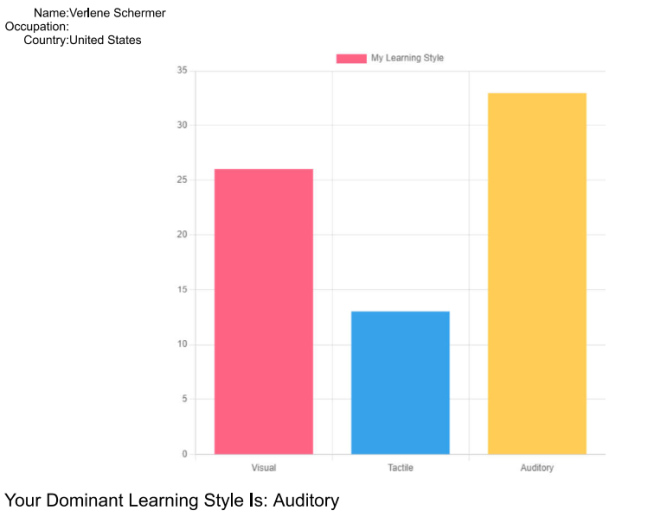
    You end up with a chart that shows your strength, and also a lot of detail and analysis. Here’s my chart:


    I won’t bore you with the 4 pages of analysis! (You’re welcome!) But notice that although my dominant learning style is Auditory, there is a strong Visual in there as well. The Tactile/Kinesthetic, not so much! This explains why I’d rather play in the band than dance on the dance floor…

    What does this mean in terms of how I “best learn” music? I actually am very good at reading music – my piano teaching mother made sure of that -- but when I look at the notes on the page, the first thing I do is sing the melody, or hear the notes in my head – that makes it easier for me to learn the tune. So an auditory learner might take the visual aspect, and translate it to how it would sound.

    A visual learner might listen to a piece, and try to picture where the notes would be on the music staff, or on their instrument, and then write out the music on paper in order to learn it.

    A kinesthetic/tactile learner might look at the sheet music and play “air harp” or “air guitar.” I was in a band with a trombonist who would play a tape (this was many years ago in the age of cassette tapes – I’m old) and he would say “listen to this” and he’d put his arms out and play air trombone. I teased him that he can’t listen to music without moving his arms. But that was his learning modality -- shame on me for teasing him!

    As you read in my blog about The Think Method, I will be teaching a class called Memory Tools for Musicians. There are visual, auditory and kinesthetic approaches covered in this class. If you’re interested in signing up, there is still room in the class (which takes place on Saturday, October 29th, from 10 am to 12 pm pacific time), but you can also opt for the video replay if you can’t attend in real time. Just send me a note saying you’d like the replay instead!

    Here’s a link to register:  https://tinyurl.com/MemoryTools


    Friday, October 14, 2022

    Creating from Scratch

    My mother was great at baking a cake “from scratch” whereas my only successful cakes came from a box mix… It got me musing about “from scratch” and how that applies to creating music compositions and songs…

    How did the phrase “from scratch” originate? It’s presumed that it comes from the scratch mark that sets the starting line in a race, so it essentially means “from the start.” 

    But it has come to mean, when talking about baking, using the original ingredients rather than a box mix which puts a lot of ingredients together for you.

    The thing is, when you bake from scratch, you have to remember to include all the ingredients, and you have to know how much of each to use. The box mix instructions usually say “just add water” or maybe just add water and eggs.” So, there is less chance of producing a flop, presuming the folks at Betty Crocker have the ingredients right. ๐Ÿ˜‰But the advantage of the “scratch cake” is that you can also improvise and produce something that is not so predictable, and not exactly like every other cake produced from that box mix.

    Okay, now we get to composition, songwriting, and even arranging traditional tunes, or making a pop song your own…

    What are the ingredients in music? Melody, Harmony, and Rhythm are the three commonly called “the elements of music.” These will produce your basic cake. Then the frosting ingredients might be dynamics, tempo, timbre (tone color), and ornaments. And then there is the overall form. For a cake, the form would be the size and shape of the pan or pans, and the final shape of the cake if it is layered – rectangle, round, heart-shaped…  

    So, before you can create music from scratch, a basic understanding of how each ingredient will affect the end result is needed. What is the alternative? Baking a box mix cake might be like creating a predictable piece of music – everything is expected, with no surprises. And even if you decorate your cake creatively, the taste will be what you’d expect from a box mix. And therefore, not all that memorable. Music composed using ingredients that are predefined from composition rules, can also lack that special quality that makes people remember it, or talk about it. So, it’s not just about “getting it right” but about improvising and substituting and breaking some of the rules. “Think outside the box mix…”

    Let’s go back to the starting line, the scratch mark that says go. What makes you take off? Is it like a race to see if you can finish first, or is it a lightbulb idea? Are you required to write, or inspired to write? In order to develop that basic understanding of the musical ingredients, you’d need to do a lot of experimental writing, and maybe even some specific assignments. And every so often, while doing a required assignment, you may find yourself inspired to take it all the way to the finish line!

    I just finished a three-part Songwriting Online course that is also available as a video replay on my website at: https://verlene.com/workshops.html#all3

    And I taught an online class called “Composing Start to Finish” last Spring that I will teach again this coming Spring. This one is not available on my website to protect the ideas coming from the participants, but it’s a fun class to take, so keep watch for that one to come up again! If you’re not on my mailing list, or on it but not getting my monthly workshop notifications, let me know and I’ll “tag” you for those! You can also join the list and choose your tags here: https://verlene.com/contact.html#list

    Late breaking news! My song El Nino is one of the songs featured in today's Women of Substance radio podcasts. The theme for the shows starting on 9/11/22 has been "Songs with a Conscience" and 4 of my songs have been featured. You can listen to today's show at any time today or in weeks to come! And while you're there, scroll down the page to find the other shows my songs are in (#1387, #1389, and #1393): https://www.wosradio.com/listen


    Friday, October 7, 2022

    Something to think about…

    Does anyone else remember watching The Music Man? I remember being impressed by what the con man, Harold Hill called “The Think Method” or maybe it was “The Think System.” A refresher (or an explanation for those who never saw the musical):

    The con man comes to a small town to sell band instruments with the promise that he’ll teach the kids so they can have a band. The instruments arrive, and he stands in front of the class with nothing to teach so he says, “If you want to play the Minuet in G, you have to first think the Minuet in G” and has them all sing along with him:

    He walks out while they’re all still singing. There’s of course a love story, and then the town finds out he’s a con, and they are about to tar and feather him, when the kids come marching out playing the tune on their instruments (out of tune, and very poorly) to save his hide. 

    So, is there something to this method? I think so! I like to listen both actively and passively to a new tune to learn it until I am singing it in my head. This way when I go to play it on harp, or violin, or guitar, or nyckelharpa… I know what it’s supposed to sound like. Then as I develop my muscle memory for where those notes are, I often don’t even need to read the notes. Just play it by ear, now that my ear knows it! As Harold Hill said, “you don’t need to bother with notes.” And when I do read the notes after listening and humming along, I find that I don’t have to spend as much time looking at the notes.

    Once I have learned a tune, even if it’s not yet polished, I often will record myself playing it and listen to that recording, which further integrates the sounds and the fingering, since hearing my own playing triggers a muscle memory reaction.

    I really prefer playing without a music stand in front of me, and am working toward having all 4 hours worth of music we do in Gaelic Muses so well integrated that I don’t really need to look at the music. I will probably always have the book on a music stand for these performances, even if it’s just to be able to glance and say “oh yeah, it’s that one next” or “oh, yes, I start this one –” or other specifics about our arrangement of a tune. But always having to keep my eyes on the music puts a barrier between me and the audience, and also makes it more challenging to have good eye contact with the other band members. So this is the goal. Think: La di da di da di da di da…

    For this morning’s 2-hour background music harp gig, I made mini sets of tunes I know by ear organized by key, and then cut out little slips of paper with each set. Those lived in the little purse tied to the back of my harp, and I just pulled one out at a time, and played the 5 tunes in the set, then set it aside. This is a great way to keep track of time. I had 8 sets of 5 tunes, with each being approximately 15 minutes in length, so they easily filled the 2 hours. Set up was easy since there was no music stand, music stand light, binder with music, and clips to hold the music in place. Just tune up and play!

    The one disadvantage of not using a music stand is that people constantly walk up to me and try to start a conversation. “Is that a real harp? The ones I’ve seen are much bigger and made of gold.” “We had a harpist at all our kids’ weddings. Do you play for weddings?" "Is that an Irish harp? I've been to Ireland 3 times. Are you from Ireland? No? Have you ever been? No? You should go!" ๐Ÿ˜‚

    If you want to learn some really great Memory Tools for Musicians, I’ll be teaching this as an online workshop on 10/29/22 from 10 am to noon pacific time! Here’s a link to register:

    https://tinyurl.com/MemoryTools


    Friday, September 30, 2022

    Fear is a Powerful Thing!

     I read an Instagram post this week that asked what we’d like to be able to go back 20 years or so and tell ourselves. Her own answer was “Stop fearing fear!” I LOVE that! And I have written several songs about this including one where I muse about what my future self would say to me. But also, a song that says that fear is a powerful thing – but love is the greater thing… And another that says, “don’t give into a fraction of the fear you feel.” And yet another that says, “let my spirit keep on growing – and I won’t fear it no more.”

    So, how do we stop fearing fear… It occurred to me that although they say “we have nothing to fear but fear itself,” to stop fearing fear, we have to acknowledge fear, face fear, and deal with it. And move on, right? So, it’s not about running from the things we fear, but standing up to them. It’s not about avoiding things that make you uncomfortable but letting them come at you until you are not cowed by them.

    And what do we fear? I know I fear confrontations and misunderstandings. It makes me not want to engage with anyone who stands on the other side of the aisle… I fear not being articulate enough to share my opinion if it differs from someone else’s. Or talk to someone that I think has prejudged me unfairly. So, I tend to steer clear rather than share my thoughts. I have nothing to fear if I avoid them -- but look at the missed opportunities to share my gifts, my strengths, and my own perspective!

    Many people have stage fright, which I haven’t really had since I was 5 years old, and found out that humor made the audience smile…  “They love me, they really, really love me!” But there are aspects of performance anxiety that I do experience – video, and live-streaming. Oh my! What if I forget the words? What if I mess up this tricky part? If it’s captured on video, it might be watched more than once, and no amount of humor is going to help those imperfections slide by unnoticed. Whereas in live performances, there is a connection between the performer and the audience that makes it okay to not be perfect.

    My song about fear being a powerful thing also has a verse that says “you can’t hide from fear, you can only turn around and face it. And you can’t fight your fear until you learn how to embrace it.” So, what does that mean for me? One more song quote: “I reach my hand out, while fear of rejection makes me tremble and fall down on my knees.” I guess I need to face my own fear of live streaming, and just go for it…  What’s the worst that can happen?

    I forget these lessons fairly frequently. So, thank you Cayla for the Instagram post that got me musing about this again.  Growth is good…

    Here’s Cayla’s Instagram post if you’d like to see it (and follow her! She’s awesome!): https://www.instagram.com/p/CicxEkPsuuA/

    And if you’d like to take a listen to the songs I mentioned above here they are on Spotify!

    Fine Tonight:

    https://open.spotify.com/track/4e4I9J0x7lwQ14oZb5KwCE?si=76f50b78d3144fdf

    A Powerful Thing:

    https://open.spotify.com/track/7aTfOVzZkQqa5sgoo8FlxU?si=ce51cc74103847c6

    Make it Real:

    https://open.spotify.com/track/10iyhBplzrcUjKxMk70gHv?si=10218bb05de74960

    The River:

    https://open.spotify.com/track/6qWTOXNbyEiqFRdZ2tFz3P?si=9931a1fa1d7f43ba

    Isolation:

    https://open.spotify.com/track/2GU9acrwipTUjMkyZxdItq

    And hey, you can also buy the full CDs these are on! Fine Tonight and a Powerful Thing are on my Peace CD, Make it Real and Isolation are on my Persephone’s Art CD, and The River is on my Rendezvous with the Moon CD. All available at https://verlene.com/recordings.html

    Musical Musings -- Change is afoot

    The last time I wrote in this blog, it was all about the new duo, Celtic Moon in January of 2024. Here it is, almost August of 2025, and I r...