Tuesday, June 27, 2023

Midsommar Musings

No, that’s not misspelled – it’s Swedish for midsummer. And why am I writing it in Swedish? I play a Swedish nyckelharpa, and this time of year there’s usually a midsommar festival in the area where I have been hired to play nyckelharpa. It’s a huge celebration in Sweden, and Swedish Americans also celebrate with music, dancing around a decorated pole much like a Maypole (Junepole?) and eat and drink all day long.

Why is Midsommar such a big festival in Sweden? I expect that when you live that far north, the longest day of the year, as well as the shortest day of the year are bigger events than they are here in the middle of California. The longest day in the farthest parts of Sweden is so long, the twilight blends into dawn.

This year, I was hired to play nyckelharpa for a very special small event by two Swedish American sisters who wanted to share a bit of their heritage with 20 of their friends. It took place in the San Francisco Bay on a tall ship, and it was a very interesting gig! I played with a wonderful multi-instrumentalist who brought just his guitar tuned in DADGAD and a tenor recorder (thanks Jim!)

The Gas Light is a72 foot schooner that can hold up to 49 people.


The idea was to play a just for 15 minutes as people boarded, then the ship would motor out to a cove off of Treasure Island, and we’d play an hour concert after they dropped anchor, and then continue with background music as they decorated one of the masts with flowers in the Swedish tradition. The hosts’ chosen music was mostly haunting, exceptionally beautiful tunes, in minor modes, and I knew we would enjoy playing them in the setting of a tall ship.

As all plans are susceptible to change, this was not exactly how it went… The idea of decorating the mast was nixed in light of the wind, and the stay at the cove was shortened to less a half hour with the more interesting option of raising the sails and sailing back rather than motoring.  There were flowers that were brought onboard to decorate, and they ended up making crowns of flowers for the women to wear.

We were all (guests and serving staff included) asked to wear white or off-white and our hosts, being fashion designers, were very much all about the aesthetics. I had to scramble to find off-white to wear – black is my go-to performance color…

As I always do, I had planned for adapting the set list to accommodate any changes, and so we began with around 30 minutes of our background music as people boarded. The little space way up in the bow is where we were set up.


We took a break as the boat motored over to the cove and then set up again topside and played a couple songs. One of our hosts did a toast and then announced we would be raising the sails to sail back. So we took our instruments back down below deck and got ready to play again once we were underway.

Even though the boat had a flat bottom and didn’t lean over as we sailed, it was still a bit of a bumpy, wavy ride, so I found standing up to play easier than sitting. The space we had was a corner with barely enough room for my little chair, so Jim sat on the built-in bench, and placed a music stand in the walkway. 

My nyckelharpa blocked the walkway, so the guests found they had to go around the table to the other side to move about. I used the table as both a music stand (that’s my black binder under the bow) and a nyckelharpa stand… 

I also found that sitting made me lose my balance whereas standing with knees slightly bent and shifting my weight from leg to leg (sort of like dancing) gave me more of a sense of being in control of my balance. So I was getting a great lower body workout as I played!

I was positioned next to the stairs up from the cabin – here’s the view I had over my right shoulder of Captain Steve at the helm:
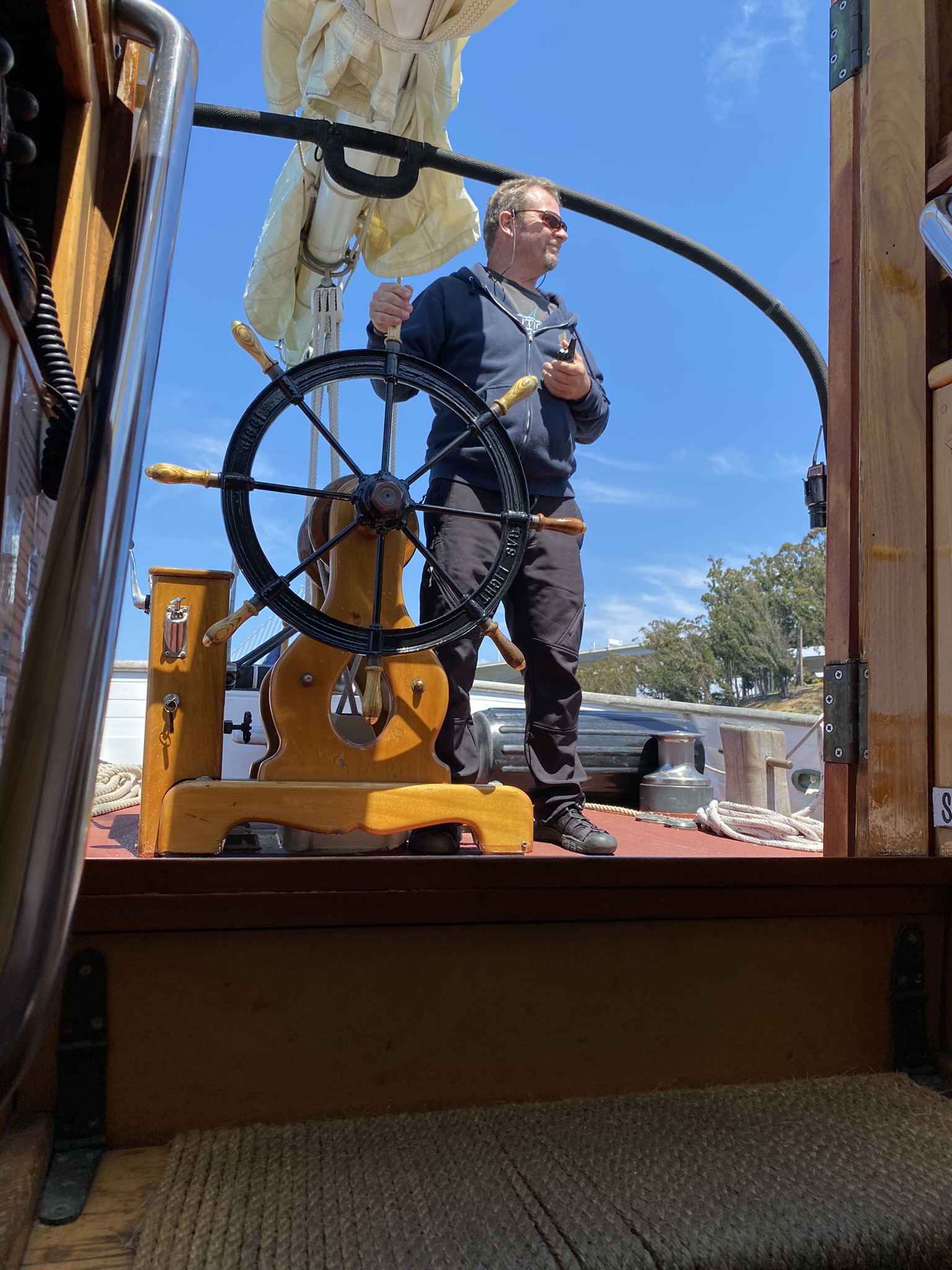
And here is Jim with the captain as he steers us back to pier 40:


 The sails were brought back down as we motored back into the San Francisco South Beach Harpbor.


It was a beautiful day, and a fun gig, despite all the changes. I have missed playing beautiful Swedish music since I haven’t been in a Scandinavian band for several years, so it was great fun to connect with Jim, who provided a solid Swedish groove and some lovely chordal textures, and to pull out not only some of my favorite tunes, but also a few new ones we learned at the hosts’ request. I hope to have more opportunities to present this music with Jim in the future. Let’s not wait until next Midsommar!


Thursday, June 15, 2023

Happy Father’s Day!

As Father’s Day approaches, I’ve been reflecting a lot about my Dad who passed away at 91 years old in 2019. Growing up in a musical family, with Mom as a piano teacher, and all four of us kids learning not only piano, but also at least one band or orchestra instrument, there was always a lot of practicing going on. We had to schedule our half hour of piano, plus half hour – hour of other instruments around school, and Mom’s piano students.

At recitals, you can imagine the pressure the “teacher’s children” felt to do our best. This is all leading up to my Dad’s role in our music, and his profound influence on me…

People would ask Dad what he plays, and he would say either “I pay for it all,” or “Someone has to be in the audience.” Always said with a twinkle in his eye. He took pride in hiding the microphone and hiding out in the kitchen to record the recitals. By the time Mom’s students had been in one or two recitals, it was clear that the recitals would be recorded, but it was fun to try to figure out where the mike was hidden…

Both my parents were involved in helping me develop my songwriting skills – Mom would make a comment about the melody, and Dad would talk about content with very specific questions like, “Who are you speaking to in the second verse?”

When my parents had company over, Dad would call me into the living room and ask me to play specific songs that I had written. You can imagine how special that made me feel!

Fast forward to the last 2 or 3 years he was with us, and he’d always introduce my sister and me as “This is my daughter who plays flute, and this is my daughter who plays harp.” Even though he had Alzheimer’s he knew which one of us played which instrument. Music seems to break through the confusion…

I wrote a handful of songs about my Dad in his final years, and recorded them on my Life Stages CD which is available as a CD or mp3s on my website (Life Stages CD (verlene.com), or listen to them on Spotify:

The Tide is about the changing roles as parents age: https://open.spotify.com/track/6eAG2pf8nrL59LChZ4gGUN?si=afb1c9dd8295441e

As Much as Before was written when Dad was diagnosed with Alzheimer’s: https://open.spotify.com/track/2r19PkMrIDwoAgPrUWXEmE?si=40202659d4e2478f

I Wanna Walk With You: https://open.spotify.com/track/1NWVEXlzpfXfidyDV5DVPo?si=b8b2e96aed304871

This last one, I will be performing at the Gaelic Muses Father’s Day performance at the Wheelhouse of Willow Glen. If you’re in or near the San Jose, CA area, it would be lovely to see you! Arrive early to get a seat and to hear the Father's Day special numbers. Here’s the info: Gaelic Muses in Willow Glen on Father’s Day – Gaelic Muses

Wishing you all a Happy Father’s Day, whether you are able to celebrate with him in person, or only in memories!

Friday, June 9, 2023

Procrastination!

I’ve started to write this blog several times and every time found something that I “needed” to do instead. Has that ever happened to you? 😂

Yes, I’m pretty sure it happens to everyone from time to time, but some are more prone to procrastinate than others. For me, it’s a matter of juggling a lot of things that have no “real” deadline. If there is a deadline, I get it done. But this “weekly” blog is really a soft deadline, so if I miss one or two or several, no heads will roll. But if I don’t learn this new tune for a gig, I will be embarrassed on stage and let my bandmates down. So prioritizing takes place on a daily basis, and while it may seem like procrastination, on further examination, it’s really a matter of shuffling the to-do list in order to make sure the top priority items get done.

I know that for many adult music students, procrastination is a big roadblock to putting in the time on their instruments.

One of my students recently told me that she was having trouble making the time to practice. She kept thinking about the other things that need to get done, and just not sitting down at her harp day after day. She loves to play, and once she sits down to play even just a warmup exercise, she finds she has the time and enjoys it. But the problem is actually sitting down to do it.

We talked about making a to-do list and checking in with it to see if she’s really not practicing because it’s not a priority, or if it’s something else. Other things that keep people from practicing are:

  1. Fear of failure
  2. Question of the value of it
  3. Sense of obligation to do something else
  4. Question of one’s right to do it

There may be more – let me know if you can think of other things that would go on this list.

So, let’s look at each one:

  1. Fear of failure – If practicing your instrument means you might fail at “perfecting” the piece, maybe you can consider practicing just a small portion. Get just the first phrase to sound beautiful. Or choose a simpler piece to learn. Find something to practice that you know you can do successfully.
  2. Question of the value of it – I think this is different from the fear of failure, in that it’s a mindset that usually comes from somewhere (or someone) else. Does someone in your family think it’s a waste of your time and effort? Is that really what you think?
  3. Sense of obligation to do something else – This may be legitimate (my need to learn a tune for the band for example) but it may also be once again imposed from outside (kids need me to bake cookies) or self-imposed (kids need me to bake cookies) and may be tied in with this last one:
  4. Question of one’s right to do it – okay, stand up for yourself! You have the right to use your time how you choose. But what some people question is whether it’s worth it to learn an instrument if you think you’ll never be “good enough” to perform. Or maybe it's that you never want to perform, so is it worth it to learn if you never intend to perform? This is tied in with number 2 as well – so first determine if this comes from your own sense of the value of it, or from someone else’s opinion.  Then remember that learning anything new is good for the mind, body, and spirit! Whether you want to play for other people or not, it’s the journey, not the destination that makes this worthwhile. And you have the right to take care of yourself by nourishing all aspects of yourself!

Please know that if you find yourself procrastinating and not getting around to your intended practice sessions, you are not the only one! But perhaps this little list can help to get to the bottom of the issue, and get you going on a more regular practice routine. And when there really are more important things that come up, and you miss a day or two or three, know that it’s a matter of prioritizing, and not a failure on your part!

I’ll be teaching an online workshop on Saturday, June 17th on “The Practice of Practicing” in case that first reason for procrastination (fear of failure) is what you identify with.  Here is the information:

Saturday, 6/17/23 10:00 am - 12:00 pm pacific time - I will be presenting a two-hour online workshop, "The Practice of Practicing." This is open to all musicians, but will focus on application to harp. (Handouts for applying to guitar are also provided.) If you have felt that no matter how much you practice, the improvement is either slow or non-existent, this gentle class will give you steps to improve your practicing practice... You'll have a step-by-step approach to learning a new piece, troubleshooting an in-progress piece, and polishing a learned piece. You'll also get tips on how to use your current works in progress to create warm-up exercises that will build some much-needed muscle memory. Cost of the workshop: $30 per person. Here’s how to register: https://tinyurl.com/PracticeofPracticing

Friday, May 12, 2023

Happy Mothers Day!

With Mothers Day coming up on Sunday, I want to thank all of the mothers in my life – my own mother in particular (who left this life in 2015), my sister, my cousins, nieces, and all my friends who have sacrificed so much in order to care for and raise their children to become responsible, kind, productive adults!

I performed a concert yesterday at one of the assisted living facilities on my regular rotation, and they had the room set up as a Mother’s Day tea with lovely eats, pink balloons, and a festive, celebratory atmosphere. I had prepared to sing a few songs in honor of the occasion and thought it would be fun to share them with you.

The first is a song that my own mother taught me when I was 4. She had me sing it as she accompanied me on piano at a mother/daughter luncheon at the church. My oh my, was that stage high! I later realized after visiting that room as an adult that the stage was no more than 6 inches! But relatively…

When my mother turned 60, (that would have been in 1990) my sister and I did a little concert for her birthday party. I rewrote the second verse of the song to make it relevant to our mother. So, this little video is from the party, with me singing and playing guitar, and my sister playing flute and singing harmony:

https://www.youtube.com/watch?v=WLHwz-CiQUM

I worked up an accompaniment of this on lever harp (lots of leaving out the third of the chord in order to not have to constantly flip levers) and sang it at yesterday’s tea.

I also did a few more that were “mother-honoring” songs, like Wind Beneath My Wings, Turn Around, and Que Sera, Sera. And toward the end of the concert, I performed a song that I had written to honor my mother’s life. I was able to play it for her just days before she passed away. I put together a video with photos and have posted it on YouTube:

https://youtu.be/YQNC1L0oZfs

Wishing you all a happy and meaningful Mother’s Day!

Friday, May 5, 2023

"By Ear" or "By Paper"

As a mentor for the Harp for Healing Certification Program, I am given most of the guitar students (most who sign up are harp students) to mentor. I have noticed more and more that guitar students are less likely to be able to read music notation and more likely to play by ear. The reverse seems to be the case for harpists, depending on their background. This isn’t universal of course – some guitarists have a classical guitar background, so can read treble clef just fine, and others are fairly fluent in guitar tablature. And with harpists, there are a number who learn tunes by ear instead of by written notation.

It got me musing about my own experiences with the various instruments I play. I started as a 4-year-old copying my brother’s piano lessons by ear until my mom (his piano teacher) put a stop to it by giving me my very own set of books and lessons and making my brother’s pieces off-limits to me. She never told me I wasn’t allowed to play by ear. It wasn’t even a thing. It was probably treated like “she’s only pretending.” But I would treat reading music as more of a reminder of how things should or will sound.

Later I chose violin for my orchestra instrument and started lessons with a private teacher. It was all about reading the notes. Or was it? Violin is an instrument you can’t play without using your ear. In order to play in tune, your finger needs to adjust – there is no fret to keep you honest… My mother used to tell people that my violin teacher said that I was never a true beginner and that I was able to get a good tone and good intonation from the start. I don’t believe I was always a hundred percent in tune, but now that I’ve had a variety of violin students, I do realize that there is a long period of time before they can really make a difference between a C and a C#...

Onward to picking up guitar: at first it was just placing my fingers in a pattern and strumming a chord. Next learning to fingerpick -- again just patterns, not music notation. But when I started guitar lessons, having already learned to read music with piano and violin, I zoomed through the Alfred’s Guitar book in two months (most of my beginning students take closer to a year) and was playing some cool classical pieces (including an arrangement of Classical Gas by Mason Williams) within a year. So, yes, I was reading music, but also figuring out the chords and picking patterns by ear from recordings of songs I wanted to play and sing.

People often tell me that I’m talented to be able to play all these things, but what it comes down to is making use of the ear, whether reading music notation or not. It’s not an either/or for me, it’s an integrated “both.” So, with each new instrument I learn, there’s a period of “Where are the notes?” followed by a “How to I make it sound like it should?” followed by the enjoyment of playing music on the new instrument. Reading music made for the instrument? just to remind me of how the tune goes. Both skills are worth developing!

I like to encourage my students to not simply follow directions or “connect the dots” of music notation, but to listen for quality, and to express their feelings about the music. Hmmm… I have more to say about expressing feelings, but will save that for another blog…

I’d be interested to know how many people find they can learn a new tune best if they hear it first, or if they see the written notation first. If you’d like to respond, please do! This is not an official survey but I think it will be interesting to know these things:

  1. What was your first instrument?
  2. When did you learn to read music? (or did you?)
  3. What instruments have you learned to play?
  4. How do you best learn to play a tune?
    • Hear it over and over
    • Hear it first then read the music
    • Read the music first, then hear a version of it
    • Read the music and count out the rhythm

This is not a competition between the “by ear” and the “paper trained” – just a look at what has worked well for you!

By the way, if you'd like to know more about the Harp for Healing Certification program, here is the website: https://www.harpforhealing.com/

Friday, April 28, 2023

Puzzling...?

Recently at a workshop taught by a compassion facilitator for our local harp organization, the question was asked, “What brings you joy, other than playing harp?” The question reminded me of a time when my husband suggested that I needed to find a hobby. My reply to him then was “I have a hobby: learning another instrument!”

But, as I dug deeper, I realized that one of my “zen” go-to’s is working puzzles – jigsaw, word games, sudoku, solitaire, and a few others, all on my iPad. So this week I’ve been very aware of how much time I’m spending, and what value it has and have come up with this neat little list:

  1. The Zen factor: I find I am settled into a place of peace, but am still aware and alert to what is happening around me.
  2. Listening to the mental soundtrack: I find I’m rehearsing using the “think method” the most recent tune I’ve been practicing, or the recent arrangement I’ve been doing for harp or guitar.
  3. Physical rest: My heart rate drops to resting or below, even to the point that sometimes my fitbit thinks I’m asleep.

So this “waste of time” that I’ve sometimes felt a bit of guilt over is really benefiting me in a number of ways. It’s not productive on the surface, but I’m also seeing how it is in a way, a different side of the same elephant.

That elephant is my drive to solve things, whether it be a tricky bowing technique on the violin, or a challenging piece on the harp, or planning and preparing a workshop. These are all aspects of my vocation, but are also my avocation… Why do I make harp and guitar arrangements? Because it’s fun and challenging, and engaging!

So, yes, I can proudly, without shame, admit that my hobby is playing games on the iPad!

But back to my vocational games: Arranging tunes for both lever harp and guitar (and in singable keys) for my workshops has been a great puzzle to work out. One key works well on lever harps tuned in Eb, but not on lever harps tuned in F or C. And then it may work in a different key on guitar, but we can put on a capo so everyone can play along. And then is it singable?

I’ll be teaching a fun Waltz class with tunes from several countries, as well as a few from pop/country, and jazz and it’s open to harp, piano, guitar, and even singers (only two of the ten tunes have not lyrics). I spend a lot of time working these arrangements up, and some might think I’m not compensated for the time I invest. But I am enjoying it – or I wouldn’t be doing it!

In addition to creating the arrangements, I do a bit more research for each tune, so I can add some background during class. The Waltz Around the World class is going to be a lot of fun to teach! If you are interested in the class, you can read more about it and register with this link: https://tinyurl.com/waltzaroundworld

It’s already starting to fill up, but I also record every workshop, and some opt to take the class via video replay.

Okay, a few more tunes to complete, and puzzles to work out, and next week’s workshop is ready to go!

Saturday, April 22, 2023

Groovy Musings

Warning! This will be more relevant to string players and harpists than vocalists, or wind or brass players!

I recently took a course called “Strum Bowing” for violinists who want to get more groove into their playing, and learned a lot of cool and groovy stuff both for violinists and other musicians to consider.

The inventor of this technique is Tracy Silverman, who along with Darryl Unger, was a member of the innovative Turtle Island Quartet. The quartet has had numerous members over the years, and Tracy was in from 1993 – 1997.  Here’s a more recent line up if you want to hear what they do: https://www.youtube.com/watch?v=xfXjOX-L2LI

So, what the heck is “strum bowing?” It’s making use of the bow to create a groove the way guitarists do with their strumming hand. On a guitar, you can strum continually down and up but when you mute the chord by lifting the pressure of your fingers but not lifting off the strings, the resulting strum sounds more like a percussive beat than a strummed chord. The groove is created by only pressing the fingers to the fretboard on the beats you want to accent, and letting the pick create the scratchy “drum” beat on all other strums.

So Tracy takes you through how to do that on fiddle, and also how to “chop” which is so percussive there is no pitch. Visit his website if you are play violin, viola, cello, or string bass and are interested in learning this technique:  https://www.strumbowing.com/ It’s a great course!

I’m loving trying all this out on violin, but it got me musing…

How does this apply to other instruments? Well, with any of my strumming instruments (tenor banjo, mandolin, guitar etc.) I can simply mute chords just like guitarists to get a rhythmic groove, emphasizing only the beats I press my fingers to the fingerboard. I’ve done that for years with bar chords on the guitar but haven’t managed to try it on banjo and mandolin because I’m often playing chords with open strings. You can also mute strings by laying your fingers across the strings if there are open strings in the chord. Need to work on that…

But what about harp?

If we want to be more percussive on harp, we usually do more damping of the strings, but to make it really groove, it’s also important to incorporate the damp into the rhythm, so that the damping sound is on the beat you mean to put it on. And that’s tricky to do, but adds to the groove in a way that simply damping whenever it’s convenient does not. Groove doesn’t just mean syncopation or other interesting patterns. It could even be just having all the notes in a melody “in the pocket.” So letting your body (strumming hand, bowing arm) keep a steady beat will help put all the notes you play in the right slots rhythmically.

With both strumming on the guitar and strum bowing, there is a consistent motion of the fastest rhythmic element, (eighth notes or sixteenth notes) but for harp, we have to pluck and then damp, which are two very different actions.

I’m still in the musing stage on this, but the key thing is to keep that unit of rhythm going somehow. I’ve suggested to students and harp ensembles to do something physically to feel where the downbeat is during a dotted quarter and eighth rhythm. I’ve suggested grunting “uh” on count 2, so it would look like:

But the problem is that the “uh” might come too soon, or the eighth note may not come immediately after so it doesn’t resolve the issue some people have of shortchanging the dotted note. A better solution may be to put in two “uh’s” so that each eighth note is felt either in the fingers or in the voice.

It’s not a good way to perform of course, but it makes sure that there are three units for the dotted quarter and one unit for the eighth. So it would be “Pluck uh uh pluck pluck.”

If I were strumming chords on a guitar with this rhythm, I can strum continual eighth notes and just press the chord on the first down, lift on the first up and second down, and then press again on the next up and the next down.

I have always put the rhythm into my body in some way, either in my shoulders, or in my torso with a very slight bounce, but so many new harpists are focused too much on playing the correct notes with the correct fingers that they are not allowing themselves to move a different part of the body to keep the rhythm.  

What may work better since the focus is on the fingers and strings would be to move the wrist very lightly down and up on eighth notes so each eighth note segment is felt in the body and not just silently counted “1 & 2 & 3 &.” Silent counting without the feeling of rhythm would not necessarily be even. In trying this out myself, I’m finding it’s actually similar to how I lead our Harpers Hall Ensemble. I know my torso and shoulders move, but I am pretty sure I’m moving my arms or hands in time as well, almost like a conductor in an orchestra.

Any of you harpists want to try the wrist concept and let me know how that feels? I intend to try it on a few of my private students.

Here’s a short video of what that might look like (this is the first A of Arran Boat Song.)

https://drive.google.com/file/d/124cduJGV_cZXsbzUkRjJ2Drwugpy9Ba_/view?usp=share_link

So, give it a try and let me know how that feels! Here’s the Arran Boat Song with lots of that rhythm in the tune. We play it in Gaelic Muses using two violins and harp, and then move into Glass Island Reel.


Thank you Tracy for giving me some new ideas!


Musical Musings -- Change is afoot

The last time I wrote in this blog, it was all about the new duo, Celtic Moon in January of 2024. Here it is, almost August of 2025, and I r...